
Dubai South is part of a broader logistics, employment and urban-expansion corridor rather than a single-airport investment story. Its demand case is supported by the Logistics District, warehousing and distribution capacity, the bonded connection with Jebel Ali Port, aviation and cargo activity, Expo City’s expanding business and residential districts, and the wider movement of Dubai’s urban coastline and communities towards Jebel Ali.
The area is not approaching maturity. Primary registrations substantially exceed resales, many projects remain under construction, and the first major phase of the airport is targeted to commence operations in 2032. Parts of Emaar South, The Pulse and other completed communities provide evidence of current occupation and resale, but those established pockets sit within a much larger market that remains launch- and delivery-led.
The practical conclusion: Dubai South is a corridor-led growth investment. The airport is an important long-term component, but logistics employment, supply-chain infrastructure, Expo City, residential delivery and the expansion of the Jebel Ali growth corridor must collectively translate into occupancy and resale demand. The project, delivery stage, entry price and evidence of project-level liquidity remain decisive.
Data cut-off: Residential evidence to 28 August 2026; DXBinteract trend data to 29 August 2026 and project rankings to 31 August 2026 · Reviewed: 31 August 2026
Key takeaways
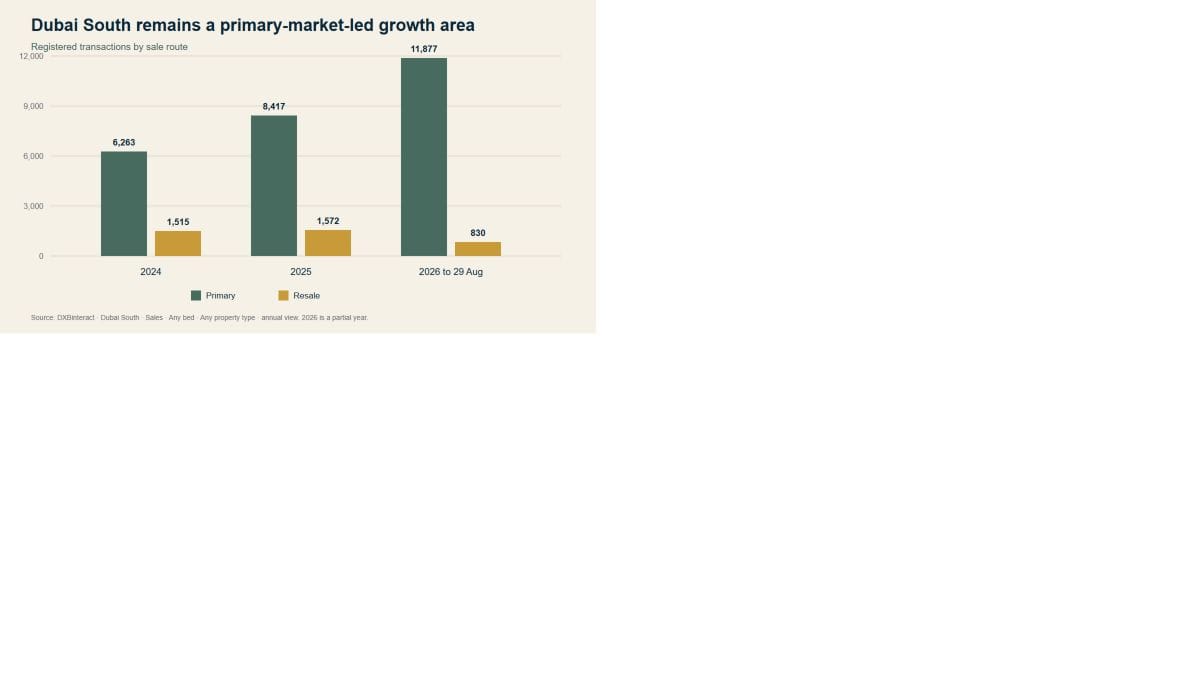
- Dubai South remains a primary-market-led growth area. DXBinteract recorded 11,877 primary registrations to 29 August 2026, compared with 830 resales, giving primary transactions a 93.5% share of the partial-year total.
- Primary activity is substantial but concentrated. The first 100 ranked primary projects represented approximately 96% of the YTD primary total, while Azizi Venice accounted for approximately three-fifths of that total.
- The resale market is broader but often thin at project level. The first 90 ranked resale projects represented approximately 93% of YTD resales, yet the leading project recorded only 42 transactions and many projects recorded fewer than ten.
- Growth is supported by several connected economic and urban drivers. Logistics, warehousing, e-commerce, Jebel Ali Port connectivity, Expo City and south-west residential expansion can broaden demand before the airport reaches its later operating phases, although none guarantees the performance of an individual project.
What the residential transaction data shows
The residential dataset covers 1 September 2025 to 28 August 2026 and contains DLD-registered transactions accessed through Bayut TruView. It should be read as a record of registrations rather than booking dates or unique buyers.
| Residential sales measure | Dubai South |
|---|---|
| Registrations | 15,061 |
| Arithmetic average transaction price | AED1,393,000 |
| Average price per sq ft | AED1,567 |
| Ready registrations | 1,433 |
| Ready average price | AED2,040,000 |
| Ready average price per sq ft | AED1,137 |
| Off-plan registrations | 13,628 |
| Off-plan average price | AED1,325,000 |
| Off-plan average price per sq ft | AED1,613 |
The higher ready-property transaction price and lower ready price per square foot do not establish that completed property is more expensive or better value. Ready registrations include larger townhouses and villas, while a substantial part of the off-plan market consists of smaller apartments. The area-wide averages therefore describe a changing product mix rather than a standard Dubai South property.
The average uses every qualifying transaction value. The median is the middle registered transaction and is less affected by unusually high or low records. DXBinteract reported a median transaction price of AED1.18 million and a median of AED1,590 per square foot for the selected 1 September 2024 to 29 August 2026 view. These figures should not be substituted for the residential trailing-12-month averages because the periods, measures and property-type filters differ.
Dubai South at a glance
| Factor | Current position |
|---|---|
| Official market geography | Dubai South; DLD records may use Madinat Al Mataar and project-level locations within the wider master development |
| Development stage | Emerging |
| Primary investor category | Growth |
| Main return mechanism | Infrastructure, employment formation, residential delivery and gradual expansion of the secondary market |
| Dominant current sales route | Primary market |
| Residential formats | Apartments, townhouses and villas across projects with different delivery stages and price points |
| Main growth drivers | Logistics and warehousing, the Jebel Ali–Dubai South supply-chain corridor, Expo City, residential delivery and the AED128 billion Al Maktoum International Airport expansion |
| Airport timing | First-phase operations targeted for 2032; ultimate development extends beyond that date |
| Suitable holding period | Primarily long-horizon, subject to the chosen project and entry price |
Who Dubai South may suit
| Investor profile | Potentially suitable route | Main condition |
|---|---|---|
| Long-horizon growth investor | Selected primary or early resale opportunity | Entry pricing must compensate for delivery time and competing supply |
| Aviation or logistics-linked owner-occupier | Ready or near-completion property | Daily amenities and actual commute pattern must work today |
| Income-focused investor | Completed project with verified rent | Yield must be calculated from matched rent, full acquisition cost and project service charges |
| Family owner-occupier | Completed or advanced master community | Schools, retail, parks and healthcare should be verified as operating rather than planned |
| Short-horizon investor | Selective only | Requires proven project-level liquidity and a realistic exit route independent of future airport delivery |
Ready versus off-plan in Dubai South
Off-plan property provides exposure to newer specifications, payment plans and the future development of the area. It also concentrates delivery, specification, valuation and handover-funding risk. In a market with substantial future supply, the exit price must compete with later developer launches and incentives as well as other investors seeking to sell before or around completion.
Ready property provides physical inspection, current service-charge information and evidence of actual rents and occupancy. It may also offer a clearer resale audience. Its limitations include older specifications, maintenance requirements and the possibility that current amenities or tenant demand remain less developed than the future masterplan.
Neither route is automatically superior. The comparison should be made within the same product category. An off-plan studio in Azizi Venice and a ready Emaar South townhouse serve different residents, carry different operating costs and are unlikely to share the same exit buyer.
Location and infrastructure context
Dubai South covers approximately 145 square kilometres within a wider south-west economic corridor. The residential districts sit near aviation, logistics and free-zone employment, with access towards Jebel Ali, Expo City Dubai and the regional road network. This economic geography matters more than describing the area as one residential community: tenant demand is likely to develop unevenly according to proximity to operating jobs, schools, retail, roads and completed community facilities.
Logistics, warehousing and the supply-chain corridor
Dubai South’s Logistics District connects directly with the cargo terminals at Al Maktoum International Airport and with Jebel Ali Port through a bonded logistics corridor. It includes the EZDubai e-commerce zone, contract-logistics facilities and warehouse space serving freight forwarding, distribution, e-commerce and third-party logistics. New multi-user and build-to-suit facilities provide evidence of operating investment in warehousing and fulfilment rather than only a future aviation narrative.
DP World’s description of the Dubai Logistics Corridor places Jebel Ali Port, Jafza and Al Maktoum International Airport within a single customs-bonded logistics system. For housing demand, the relevant mechanism is the formation of a larger employment and service ecosystem across trade, freight, fulfilment, maintenance and supporting businesses. The location of a job within that corridor will still determine whether Dubai South is the preferred residential choice.
Dubai South reported 653 new companies in 2025, taking the number of operating businesses above 4,200, with 90% retention of existing companies and 65% growth in new licences. These figures support the employment thesis but should not be treated as a direct measure of residential occupancy or rent.
Expo City and the south-west urban corridor
Expo City is developing as a mixed residential and business district rather than remaining only an event site. Its master plan includes business, residential, cultural and community districts, while its operating free zone and corporate base can create demand for homes across the surrounding corridor. Dubai South may benefit from this proximity, but the spillover will depend on travel time, available housing within Expo City itself and the relative quality and cost of competing communities.
Palm Jebel Ali and the Jebel Ali Beach programme provide further evidence that Dubai’s residential and lifestyle footprint is extending south-west. Palm Jebel Ali is officially described as anchoring a new Jebel Ali growth corridor, with extensive residential, hospitality and waterfront development. These projects are not direct comparables for Dubai South property and should not be used to transfer waterfront pricing inland; their relevance is that infrastructure, amenities, tourism and population growth are no longer concentrated only in Dubai’s established central and northern districts.
The airport remains important, but it is one part of the thesis
Dubai approved the new Al Maktoum International Airport passenger terminal at a cost of AED128 billion, with ultimate annual capacity above 260 million passengers and 12 million tonnes of cargo. A June 2026 Dubai Government update stated that the project remained on course to commence operations in 2032. The airport is therefore a government-committed long-term catalyst, while logistics, cargo, warehousing and free-zone activity provide nearer operating components of the wider economic case.
Primary growth and the developing secondary market
DXBinteract’s annual series shows how strongly Dubai South remains oriented towards developer sales. Primary registrations increased from 6,263 in 2024 to 8,417 in 2025. The 2026 count had already reached 11,877 by 29 August. Resales were substantially lower at 1,515 in 2024, 1,572 in 2025 and 830 in the partial 2026 year.
| Period | Primary registrations | Resale registrations | Primary share |
|---|---|---|---|
| 2024 | 6,263 | 1,515 | 80.5% |
| 2025 | 8,417 | 1,572 | 84.3% |
| 2026 to 29 August | 11,877 | 830 | 93.5% |
The 2026 figures cannot be compared as full-year totals, but the increasing primary share is clear. Dubai South is still absorbing new launches and registrations rather than operating predominantly through completed-stock resales. This is consistent with an emerging growth market, not a maturing one.
Registration growth is not the same as booking velocity. A transaction may be registered after the original reservation, and a project whose escrow or registration process opened later may show a concentration of registrations that does not correspond to bookings made during the same period.
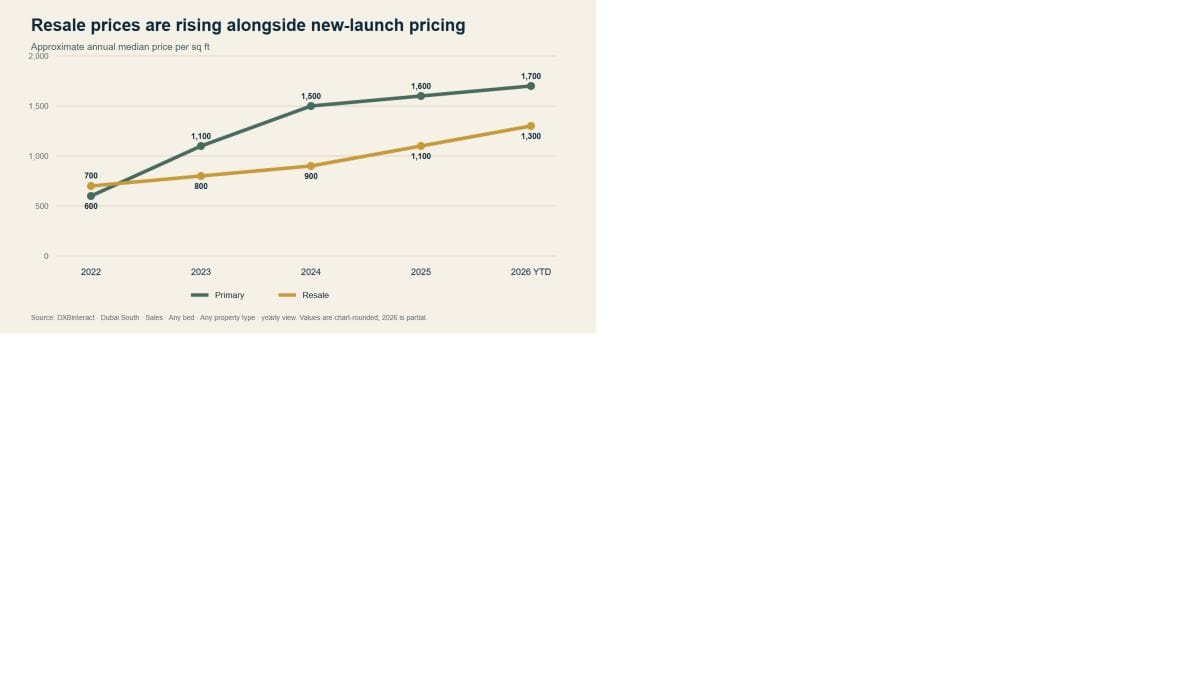
DXBinteract’s rounded annual medians show primary pricing rising from approximately AED600 per square foot in 2022 to AED1,700 in 2026 to 29 August. The corresponding resale series increased from approximately AED700 to AED1,300. This is evidence that higher pricing is not confined to new launches, although it does not represent appreciation of one unchanged property. Each annual basket contains different projects, property types and unit sizes.
The remaining primary premium reflects both newer project pricing and differences in the properties being transacted. An investor should therefore compare the selected unit with transactions from the same project, property type, bedroom count and delivery stage rather than treating the primary-resale difference as an automatic discount or premium.
How concentrated is the primary market?
NYSA reviewed DXBinteract’s first 100 ranked primary projects for 1 January to 31 August 2026. Those projects contained approximately 11,441 registrations, representing about 96% of the 11,877 registrations shown in DXBinteract’s 2026 primary-market chart. The two views end on slightly different August dates, so the coverage percentage is approximate.
Azizi Venice projects accounted for approximately 7,146 registrations in the first 100, equal to about 62% of their volume and approximately three-fifths of the total primary registrations shown by DXBinteract. The remaining activity was distributed across developments including Windsor House, Terra Woods, Golf Vale, Golf Fields, South Square, Hayat, Expo Valley Views, Golf Trails, Golf Hills and other projects.
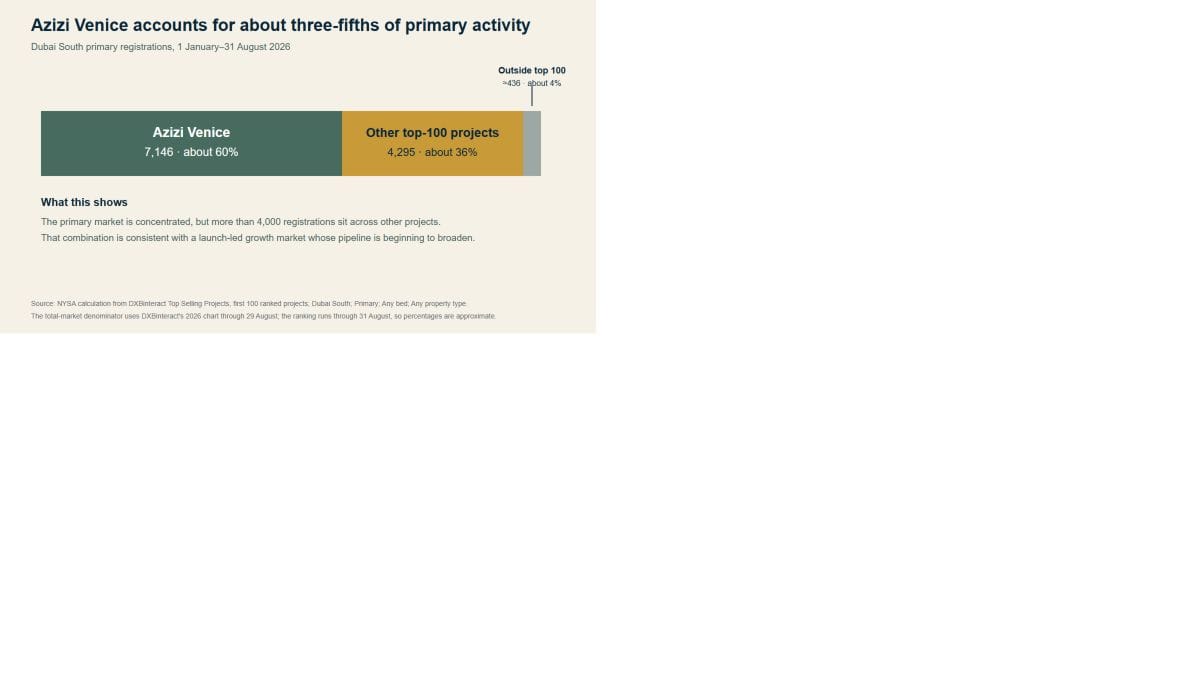
This is a concentrated market, but it is not a one-project market. Azizi Venice remains the largest contributor while more than 4,000 registrations sit across other leading projects. That combination is consistent with a primary pipeline that is still launch-led but beginning to broaden.
The DXBinteract project ranking was filtered to Any Type and includes at least one retail entry and likely land transactions. It is therefore used to measure overall primary-market concentration, not to establish residential prices or yields. Residential pricing continues to rely on the separately identified residential dataset.
What the resale ranking shows
NYSA reviewed the first 90 DXBinteract resale projects for 1 January to 31 August 2026. Those rows contained approximately 769 registrations, close to 93% of the roughly 830 resales shown in the platform’s partial-year chart. Unlike the primary ranking, no single development dominated the resale list. The highest-ranked project recorded 42 registrations, while many projects recorded fewer than ten.
Resale activity was distributed across Discovery Dunes, The Pulse, MAG and Celestia buildings, Parkside, Expo Golf Villas, South Bay, Fairway Villas, Azizi Venice, Mangrove Residences, Urbana and other projects. Azizi Venice contributed approximately 125 registrations across the first 90 resale rows, materially below its share of primary activity.
The secondary market is therefore broader by project name but often thin within an individual development. Area-wide resale volume does not guarantee that a specific building or villa phase can absorb a sale quickly at the expected price. Investors should examine recent comparables and transaction frequency for the exact project and property type.
Resale also does not automatically mean completed. A secondary transaction may involve an off-plan contractual interest. Completion status, assignment conditions and handover timing must be checked separately.
Rental evidence and retained yield
The residential rental dataset recorded 8,256 rental transactions during the trailing 12 months, with an arithmetic average annual rent of AED80,405 and an average of AED74 per square foot. Rental registrations increased and the data demonstrates that a functioning rental market exists alongside the off-plan pipeline.
Dividing the area-wide average rent by the area-wide average sale price produces an indicative ratio of approximately 5.8%. It is not a reliable expected yield because the rental and sales averages do not necessarily represent matched properties. A decision-grade yield requires the same project, property type, bedroom count, completion status and period.
The platform’s displayed 8% rental yield is also an area-level estimate whose matching and cost assumptions are not visible in the screenshots reviewed. It should not be presented as an investor’s expected return without project-level verification.
Net operating income should be calculated from collected rent after vacancy, leasing and management costs, RERA-approved service charges, landlord-paid utilities, maintenance reserves and insurance. Dubai Municipality’s housing fee is generally assessed using rental value. It is ordinarily paid by the tenant through DEWA for a tenanted property and by the owner when the property is self-occupied. It should therefore form part of an owner-occupier’s annual budget but should not normally be deducted from a landlord’s rental income when the tenant bears the charge.
Project and unit-selection tests
- Verify whether the project is complete, under construction or at an early registration stage, and distinguish the reservation date from the DLD registration date.
- Compare the unit only with the same project, property type, bedroom count and delivery stage; Dubai South’s area-wide price range is too broad to serve as a valuation.
- Obtain the current RERA-approved service charge for the exact building or community and calculate net yield against the full acquisition cost.
- Confirm which schools, retail, healthcare, parks and transport connections are operating today and which remain developer-stated or planned.
- Examine competing units scheduled to complete near the intended exit date, particularly where several projects target similar apartment sizes and buyer budgets.
- Review layout efficiency, parking, orientation, road exposure, future construction, plot usability and the likely priorities of the eventual tenant or resale buyer.
- For off-plan purchases, review escrow registration, payment milestones, assignment restrictions, mortgage availability at handover and the developer’s delivery evidence.
Infrastructure and delivery timeline
| Status | Development | Investment relevance |
|---|---|---|
| Operational | Existing DWC, logistics, aviation, free-zone and residential activity | Provides current employment and occupancy demand |
| Under construction | Al Maktoum International Airport expansion and multiple residential projects | Supports long-term demand while adding execution and timing exposure |
| Targeted for 2032 | Commencement of the airport’s first major operational phase | Potential step-change in employment and connectivity; not a near-term rent guarantee |
| Long-term development | Ultimate airport capacity above 260 million passengers and wider city formation | Supports a multi-cycle investment thesis whose benefit will develop unevenly |
Principal investment risks
- Delivery and timing risk: major infrastructure and residential handovers extend across several years, so the benefit may emerge later than an investor’s funding or exit timetable.
- Primary-market concentration: a large share of registrations is associated with one master development, increasing exposure to its construction, delivery and resale performance.
- Competing supply: future launches and handovers may compete for tenants and buyers with similar unit sizes, payment plans and price points.
- Project-level liquidity: area-wide transaction growth can coexist with limited resale depth in a particular building, phase or property type.
- Product-mix distortion: area averages combine apartments, villas, townhouses and, in the DXBinteract Any Type ranking, some non-residential transactions.
- Infrastructure-price risk: a launch price may already capitalise part of the future airport and employment narrative before the corresponding occupancy and rent have developed.
These risks do not make Dubai South unsuitable. They determine the required entry price, holding period, evidence standard and margin of safety.
Area decision
Dubai South offers a credible corridor-led growth case supported by logistics and warehousing investment, the Jebel Ali supply-chain system, Expo City, south-west residential expansion, a committed airport programme and a rapidly expanding primary market. The evidence also shows why the entry decision cannot rest on the regional narrative alone. Primary activity is concentrated, the future supply pipeline is substantial, and project-level resale liquidity varies widely.
The area is most suitable for investors who can hold through construction and community formation, select a project with a clear resident and exit audience, and avoid paying a launch premium that assumes the future infrastructure benefit has already arrived. Completed projects may offer stronger evidence for rent and resale, while carefully selected off-plan property can retain early-entry advantages when the price, specification and payment structure compensate for delivery and supply risk.
The investment view would weaken if future launches substantially outpace absorption, airport delivery moves materially beyond the current target, operating amenities fail to keep pace with residential handovers, or project-specific resale volumes remain too low to support the required exit.
Dubai South investment FAQs
Is Dubai South an established or emerging property market?
Dubai South should be classified as emerging. It contains completed and occupied communities, but primary registrations dominate, substantial residential and infrastructure delivery remains ahead, and the airport’s first major operational phase is targeted for 2032.
Does Azizi Venice account for most Dubai South transactions?
It accounts for a large part of primary activity. NYSA’s review of DXBinteract’s first 100 ranked primary projects found approximately 7,146 Azizi Venice registrations, equal to about three-fifths of the platform’s 2026 year-to-date primary total. Its share of the resale ranking was materially lower.
What is the average property price in Dubai South?
The residential trailing-12-month dataset recorded an arithmetic average price of AED1.393 million and an average of AED1,567 per square foot. DXBinteract showed a median of AED1.18 million and AED1,590 per square foot for a different 24-month, any-property-type view. Neither figure should be used to value a specific unit without matching the project and property type.
What rental yield can an investor expect?
An area-wide expected yield cannot be established reliably from blended sales and rental averages. The guide’s 5.8% calculation is an indicative ratio only, while DXBinteract displayed an 8% area estimate. A usable yield requires matched project-level sale and rent evidence, service charges, vacancy and other ownership costs.
Does resale activity prove that a project is complete?
No. Resale identifies a secondary transaction and may include a transfer of an off-plan contractual interest. Completion status and assignment conditions must be verified separately.
What is the principal investment risk?
The central risk is paying today for infrastructure, occupancy and exit liquidity that may take several years to develop. The practical mitigation is not to avoid the area, but to ensure that the entry price, developer, unit selection, payment structure and holding period compensate for that exposure.
Methodology and sources
Residential sales and rental figures cover 1 September 2025 to 28 August 2026 and were accessed through Bayut TruView’s DLD-powered market analysis. DXBinteract figures were transcribed from the user-reviewed Dubai South screens on 31 August 2026. Trend views were filtered to Sales, Any Bed and Any Property Type; project concentration views were filtered to YTD, Primary or Resale, Any Bed and Any Type. The ranked primary review covers the first 100 projects, and the ranked resale review covers the first 90.
Because the DXBinteract rankings include non-residential entries, they are used for market structure and concentration rather than residential valuation. Percentages are approximate where the platform’s annual chart ends on 29 August and its project ranking ends on 31 August. Registration counts are not treated as booking dates or unique-buyer counts.
Primary data, infrastructure and economic sources:
- DXBinteract, Dubai real-estate market reports and the user-reviewed Dubai South Trends and Top Selling Projects screens, accessed 31 August 2026. These screens provide the primary/resale annual series, rounded price-per-square-foot trends, rental-yield display and ranked-project data used in this guide and its charts.
- DXBinteract, Market Matrix, for the platform’s description of its market-data framework.
- Dubai South, Multiuser logistics facilities supporting regional logistics growth, covering warehousing, freight, e-commerce and the bonded Jebel Ali connection.
- Dubai South, Dubai South and Aldar build-to-suit facility for Kuehne+Nagel, covering third-party logistics, e-commerce and warehousing capacity.
- DP World, Strategic Location and Dubai Logistics Corridor, describing the customs-bonded connection between Jebel Ali Port, Jafza and Al Maktoum International Airport.
- Expo City Dubai, The Expo City Dubai master plan, covering its residential and business districts.
- Dubai Media Office, Palm Jebel Ali master plan, describing the new Jebel Ali growth corridor and planned waterfront development.
- Dubai Media Office, Jebel Ali Beach Development Project, covering the planned 6.6-kilometre public beach and associated amenities.
- Dubai Media Office, Mohammed bin Rashid approves designs of new passenger terminal at Al Maktoum International Airport, 28 April 2024.
- Dubai Media Office, Al Maktoum International Airport development project achieves significant milestones, 15 June 2026.
- Dubai South, Dubai South concludes a strong 2025, attracts 653 new companies.
- Dubai Municipality, Adjust Housing Fees, covering leased and owned units based on rental value.
This guide provides general market information and is not investment, legal, tax or financial advice. A property decision requires project-specific legal, technical, financial and market due diligence.
Explore Dubai investment areas
Explore Areas & Communities or request a project-level investment assessment based on matched transactions, current service charges and a realistic exit route.