
Data does not make a good property investment. A disciplined decision process does.
Dubai investors can now access transaction records, rent data, project status, construction progress, payment plans, service charges and price-per-square-foot comparisons. Yet more information has not removed poor decisions. In some cases, it has simply made the sales pitch more sophisticated.
A brochure can quote market growth. A portal can calculate gross yield. A dashboard can compare areas. None of them, by itself, establishes whether the entry price leaves room for appreciation, the income is sustainable or the capital is being deployed effectively.
Data is an input. Investment judgement is the process that turns it into conviction.
Why data requires a framework
Dubai Land Department provides official data across transactions, rents, projects, valuations, buildings, units, brokers and developers. Project records can include the developer, escrow account, status, completion percentage and inspection date. Dubai REST adds practical access to project and ownership services.
This transparency is valuable, but property analysis is not automatic. A buyer seeking immediate income should emphasise achievable rent, occupancy, recurring costs and tenant depth. An off-plan investor should focus on early-entry pricing, payment leverage, developer execution, competing supply and the likely market at handover.
Definitions matter. Asking price is not completed price. Gross yield is not cash flow. Area-wide growth does not establish one building’s value. Announced supply is not delivered supply. Historical appreciation is not a forecast.
Start with the investor, not the asset
Most property discussions begin with: Which project should I buy?
The better first question is: What should this capital achieve?
An investor should define:
- the holding period;
- the priority between income, growth and personal use;
- the amount and timing of available capital;
- the funding structure—cash, mortgage or developer payment plan;
- the capacity to absorb vacancy, delay or a slower exit;
- the expected exit route.
These choices determine whether off-plan or ready property is relevant and which route offers the stronger expected return. A good property can still be a weak use of a particular investor’s capital.
The four layers of analytical property selection
The assessment should move from broad conditions to the specific unit. Starting with a favourite property often leads investors to search for data that supports a decision already made.
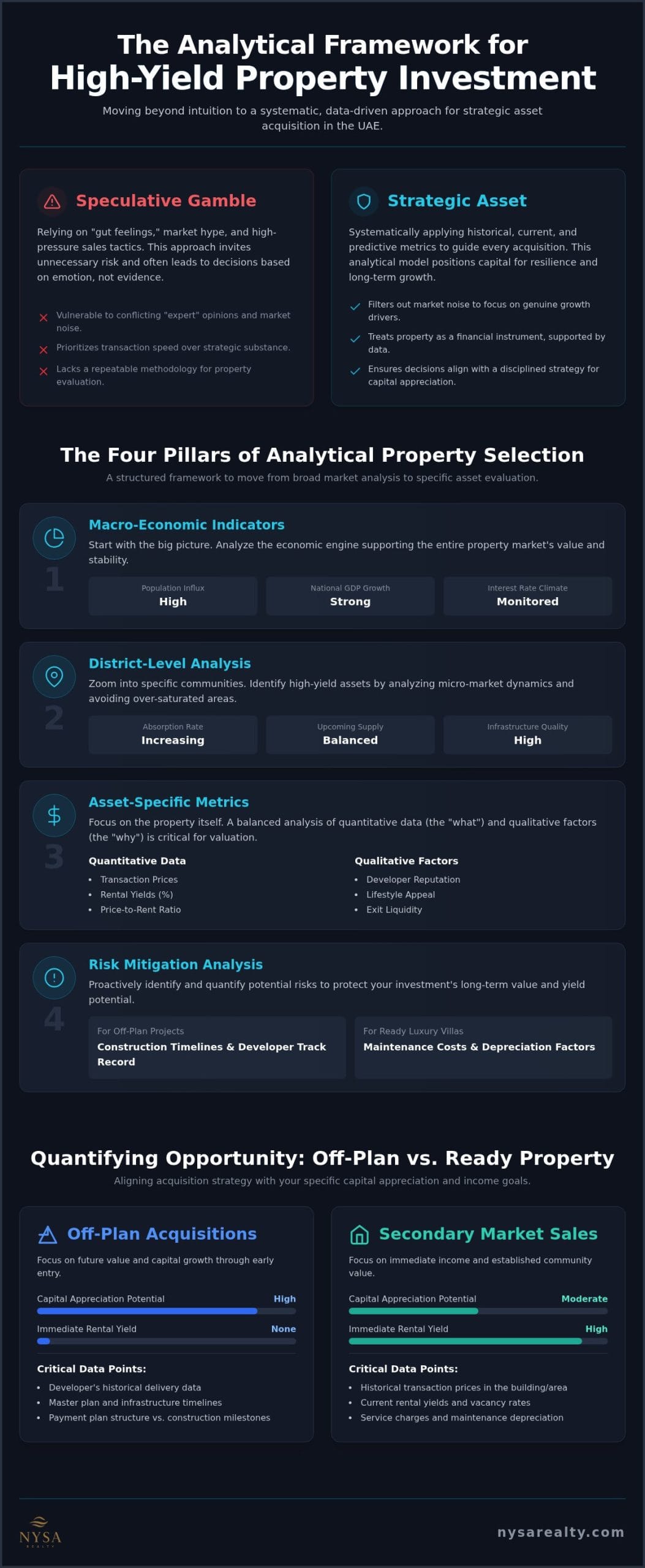
The accompanying infographic is a conceptual comparison and evaluation framework. Labels such as “high” or “moderate” illustrate different investment profiles; they are not forecasts or guaranteed outcomes.
1. Market conditions
Begin with population and household formation, employment, business activity, borrowing costs, transaction liquidity, launches and the delivery pipeline.
Dubai Land Department reported AED 252 billion in real-estate transactions in Q1 2026. That demonstrates market scale and activity; it does not prove that every project is correctly priced.
The practical question is whether economic and demographic drivers are likely to support demand for the chosen asset type during the holding period. Even in a strong city-wide market, outcomes diverge between communities, buildings and unit categories.
2. District and community
Assess completed transactions, registered rents, transaction frequency, current inventory, future supply, connectivity, amenities and the likely tenant or end-user base.
Comparables must be genuinely comparable. Adjust for age, specification, view, floor, service charges and access. High transaction volume may indicate deep demand, or simply aggressive launch activity. Numerous listings may show liquidity, or competing sellers.
The objective is not one supposedly perfect valuation. It is a defensible value range and a clear view of what could move the property within it.
3. Asset economics
For a ready unit, begin with achievable rent and deduct the costs required to produce it:
Gross annual rent minus service charges minus management, leasing and maintenance minus vacancy and financing costs = estimated annual cash flow
Include acquisition and disposal costs when measuring the investment across its full life. Headline yield can hide high service charges, recurring maintenance or weak resale demand.
Then examine layout efficiency, natural light, view protection, floor, parking, noise, building management and shared facilities. Two equally sized units can perform differently because tenants and future buyers do not regard them as identical assets.
4. Return mechanism and exit
Ask where the upside comes from, how much is already priced in and whether the expected return is sufficient for the exposure.
For ready property, value may come from net income, asset improvement, disciplined entry pricing and resale demand. For off-plan, it may come from early-phase pricing, construction progress, area maturation, payment leverage and a stronger market at handover. The investor should be able to name the mechanism expected to create value.
Dubai’s escrow and project-registration framework gives off-plan investors a stronger factual base. DLD states that purchasers’ funds for off-plan units are deposited into a project escrow account, while official services allow progress checks.
Before buying, identify the likely future buyer, relevant transaction depth and the conditions under which the asset may need to be sold. A profitable model is less useful when exit liquidity does not match the investor’s timeframe.
Off-plan: analysing a future asset
An off-plan investor buys an asset that does not yet exist in its final form. The analysis therefore combines verified facts with explicit assumptions about delivery and the future market.
Review:
- official project, developer, progress and escrow records;
- the developer’s delivery history;
- launch price against relevant ready and off-plan comparables;
- payment milestones and total capital exposure;
- assignment or resale restrictions;
- competing supply at handover;
- conservative rent and resale ranges after completion.
A payment plan changes cash-flow timing; it does not reduce the total price or guarantee appreciation. Flexible terms may already be priced into the asset. Separate financing convenience from property value.
Off-plan can create strong return asymmetry when entry price, developer, payment structure, area development and holding period align. It becomes speculation when the thesis rests mainly on launch urgency or an assumption that prices must rise before completion.
Ready property: analysing an operating asset
Ready property offers more observable evidence. Investors can inspect the unit, assess building quality, verify current rent and compare completed transactions. That visibility creates an opportunity to price the asset more precisely.
Review:
- completed sales for genuinely comparable units;
- current tenancy terms or supportable market rent;
- service charges and maintenance history;
- building condition and management quality;
- vacancy and transaction activity;
- net return after recurring costs;
- mortgage sensitivity, if financed;
- depth of the future buyer pool.
Ready property can deliver income and growth when acquisition price, achievable rent, building quality and future demand combine effectively.
Data quality and scenario testing
An investment model is only as reliable as its inputs. Know whether prices are asking or completed, areas are gross or net, rents are contracted or advertised, and supply is announced, under construction or delivered. Record when data was updated and which assumptions were added by the investor or adviser.
Then test how the return changes. For a ready asset, model lower rent, vacancy, higher maintenance and slower resale. For off-plan, test delayed handover, lower completion value, tighter mortgage conditions and added competing supply.
This is not about avoiding risk. It identifies the variables that matter most and highlights opportunities where upside remains attractive across a reasonable range of outcomes.
From information to acquisition
Record the same fields for every shortlisted property:
- Total acquisition cost
- Evidence-supported value range
- Estimated annual cash flow
- Base, downside and upside assumptions
- Principal return drivers and unresolved questions
- Fit with the intended holding period
- Expected exit market
This makes it possible to compare a visually attractive launch with a cash-generating ready asset using the same capital-allocation logic. It also ranks opportunities by expected return rather than marketing intensity.
The investor does not need to avoid risk. The investor needs to be paid for taking it.
The advisor’s role
Not every source of upside exists in a database. Developer behaviour, building management, layout usability, view protection and future competition still require investigation and judgement.
The advisor should separate verified facts from assumptions, choose relevant comparables, show where returns can be created or diluted, and relate the property to the investor’s objective. Data becomes useful when it disciplines judgement—not when it tries to replace it.
Final thought
Data-driven property investment is a method of pursuing stronger returns with greater conviction.
Begin with the investor, move through market and community evidence, test the asset economics and finish with the return mechanism and exit. Use official records where possible, label forecasts and challenge every material assumption.
Dubai will continue producing a large number of opportunities. The investor’s advantage will not come from seeing the most projects. It will come from recognising where future demand may be mispriced—and acting before that view becomes obvious.
NYSA helps investors and homebuyers compare Dubai property against their return objective, funding strategy and holding period. For an advisor-reviewed opportunity comparison rather than a sales shortlist, speak with NYSA about your investment brief.
Frequently asked questions
What is the most important property-investment metric?
There is no universal metric. Entry price, net income, future supply, holding period and resale liquidity interact. The priority depends on what the capital is intended to achieve.
Is off-plan better than ready property?
Neither is inherently better. Off-plan may offer early entry, payment leverage and area maturation. Ready property may provide immediate income, observable quality and a clearer operating history. Choose the stronger expected return for the investor’s capital and timeframe.
How can an investor verify a Dubai off-plan project?
Dubai Land Department and Dubai REST services provide project, developer, completion and escrow information. Combine these checks with review of the sale agreement and appropriate legal advice.
Can data predict future property prices?
No. Transactions, rents, supply and economic indicators can define reasonable scenarios and show where appreciation may be supported. They cannot create certainty.
Data and regulatory references
- Dubai Land Department real-estate data
- Dubai Land Department guidance on escrow accounts and project progress
- Dubai REST services and off-plan project information
- Dubai real-estate transactions in Q1 2026
This article provides general information, not financial, legal or tax advice. Property values, rents, costs and financing conditions can change. Verify current information and obtain advice appropriate to your circumstances before committing to a transaction.